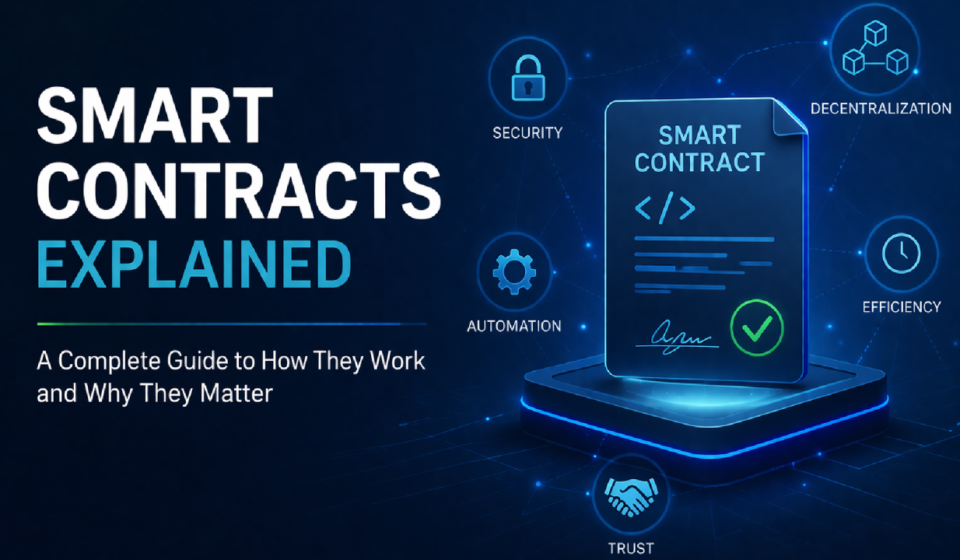

Blockchain-based known as “smart contracts” are made to automatically carry out predetermined tasks when certain requirements are satisfied. The regulations are written into code and carried out by the blockchain network rather than relying solely on a central authority or middleman. for instance, are programs on Ethereum that are stored at blockchain addresses and that users can interact with via transactions.
What Are Smart Contracts?
One way to think of a smart contract is as a software-driven digital contract. It has data and functionalities that control how users interact with it. Its code can run in accordance with predetermined rules once it is installed, producing automatic and predictable results.
The idea is frequently likened to a vending machine: the program process generates the desired output when the right input is supplied. A similar idea is applied to digital transactions and applications by smart contracts.
How Smart Contracts Operate?
There are typically four steps in the process:
- Development: Using a programming language like Solidity or viper that is compatible with blockchain technology, developers create the contract.
- Deployment: After compilation, the code is sent to a blockchain network.
- Interaction: One of the contract’s functions is called by a transaction sent by a user or application.
- Execution: The transaction is processed and the associated state changes are recorded by the blockchain network.
The computing resources needed to run smart-contract code on Ethereum are often quantified in gas, and transaction senders cover the related network expenses.
Key Features
Automation
When predetermined criteria are met, smart contracts have the ability to execute automatically. This may lessen the need for middlemen and manual processing.
Openness
Smart-contract code and transaction activity can be made visible by public blockchain networks, enabling users and developers to analyze how apps function.
Deterministic Implementation
A well-crafted smart contract generates outcomes based on its p reprogrammed logic. Compared to systems that mostly rely on human interpretation, automated processes are therefore more predictable.
compos-ability
Because smart contracts can communicate with one another, developers can incorporate per-existing blockchain components into more intricate applications. Within its ecosystem, contracts operate similarly to open a pis, according to Ethereum.
Typical Applications

Several applications of blockchain technology make use:
Financial Decentralization
stable coins, loan systems, decentralized exchanges, and other programmable financial services can all be powered by them.
Digital Resources
Tokens and other blockchain-based digital assets can be created and managed .They are able to specify functions such as supply rules, ownership, and transfers.
Playing games
Smart contracts can be used in blockchain games to control ownership, rewards, transactions, and digital assets.
Insurance
When trustworthy conditions and data are available, smart contracts can automate some insurance procedures. Automated insurance payouts are one example of its possible usage in Ethereum documentation.
Applications that are decentralized
In decentralized applications, smart contracts often function as the back end logic, and users can interact with them through a fronted interface.
Risks and Difficulties
The mere fact that smart contracts operate on a blockchain does not guaranty their security. Vulnerabilities may result from programming flaws, and once a transaction is executed, it may be difficult or impossible to undo it. Ethereum observes that contracts cannot typically be removed after deployment and that smart-contract interactions are typically irreversible.
Access to real-world data is another barrier. Arbitrary off-chain data cannot be independently retrieved by a blockchain smart contract. When an application needs data from outside the blockchain, external oracles can supply it.
Therefore, before deploying apps with valuable assets, developers must conduct thorough testing, security evaluations, and proper contract architecture.
Smart Contracts’ Future
Smart contracts are emerging as a key component of the digital economy and blockchain-based technologies. They are helpful for digital assets, marketplaces, gambling, banking, and other applications because they can integrate decentralized infrastructure with programmable rules.