What exactly are Neural Networks?
A Neural network is a machine learning model that maps inputs to outputs by stacking basic “neurons” in layers and learning pattern-recognizing weights and biases from data.
One of the most important algorithms in contemporary machine learning and artificial intelligence (AI) is neural networks. They support advances in speech recognition, computer vision, natural language processing (NLP), and other practical uses, such as facial recognition and forecastin.
How do neural networks work?
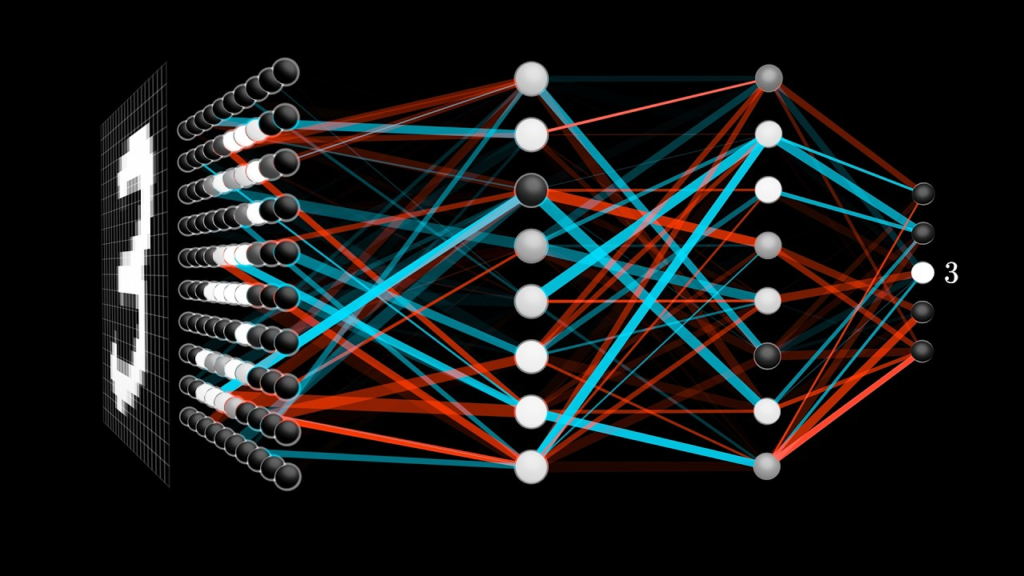
The biological neurons in the human brain, which exchange electrical signals, serve as a major source of inspiration for neural networks.
The first mathematical model of a neuron was proposed by Warren McCulloch and Walter Pitts in 1943, demonstrating that basic units could compute a function. Frank Rosenblatt first presented the perceptron, an algorithm for pattern recognition, in 1958. The perceptron, which is essentially a linear model with a limited output, is the historical progenitor of modern networks.
A neural network is comprised of:
- Input layer: holds the raw features (X1,X2,X3,..) .
- Artificial neurons, also known as nodes, make up hidden layers, which convert inputs into new representations.
- Output layer: A nonlinear activation function (tanh, sigmoid, or ReLU) for regression or a probability distribution for classification is added to the final prediction (such as a number) after the linear transformation in the hidden layer.
Types of neural networks
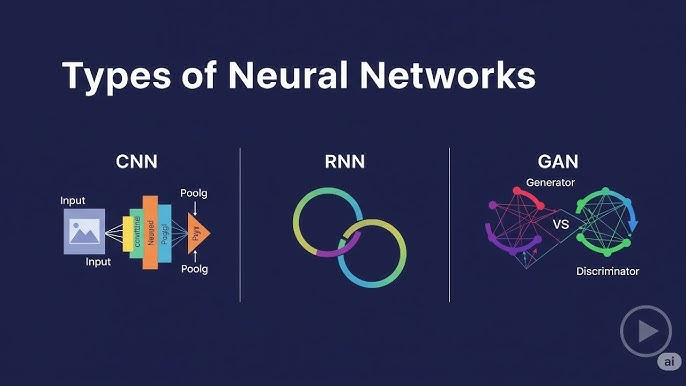
- Although multilayer perceptrons form the basis of neural networks, they have developed into specialized architectures suitable for different do. Convolutional neural networks, often known as convnets or CNNs, are made for data that resembles a grid, like pictures. Convolutional filters that identify spatial hierarchies of features enable CNNs to perform exceptionally well in image identification, computer vision, and facial recognition.
- Feedback loops that enable information to endure over time steps are used into recurrent neural networks (RNNs). RNNs work well with sequential data, time series forecasting, and speech recognition.
- Transformers: For many sequence jobs, this contemporary architecture took the place of RNNs. Transformers fuel cutting-edge models like GPT by using attention methods to capture dependencies in natural language processing (NLP).
- These variations demonstrate how adaptable neural networks are. Artificial neurons, nonlinear activations, and optimization algorithms are the same concepts that underpin all architectures.
Why do neural networks matter?
They scale from tiny benchmarks to production systems in computer vision, natural language processing, speech recognition, forecasting, and more with adequate capacity, sensible goals, and regularization against overfitting—delivering quantifiable improvements in accuracy and resilience. Modern deep learning builds upon these roots. With the help of residual connections, normalization, and effective GPU parallelism, transformers replace recurrence with attention; CNNs specialize in spatial feature extraction for images; and RNNs describe temporal relationships in sequences.
From a multilayer perceptron to the most advanced generators, architecture, data, and computation play a major role.