Agentic AI vs AI Agents is an increasingly important distinction as businesses adopt AI systems that can reason, plan, use tools, and complete tasks with less human intervention. Although the terms are often used interchangeably, they describe related but different concepts. A 2026 review in Information Fusion distinguishes AI agents as task-oriented systems and Agentic AI as broader, coordinated architectures capable of dynamic task decomposition and multi-agent collaboration.
What Are AI Agents?
An AI agent is a software system designed to pursue a particular goal by interpreting information, reasoning about what to do, and taking actions. Unlike a basic chatbot that mainly generates responses, an AI agent can connect with tools, APIs, databases, or other software to perform tasks.
For example, an AI customer-service agent could:
- Understand a customer’s question
- Retrieve account information
- Check an order status
- Generate a response
- Update a support ticket
AI agents are generally designed around specific tasks or workflows, although their autonomy can vary considerably depending on how they are built.
What Is Agentic AI?
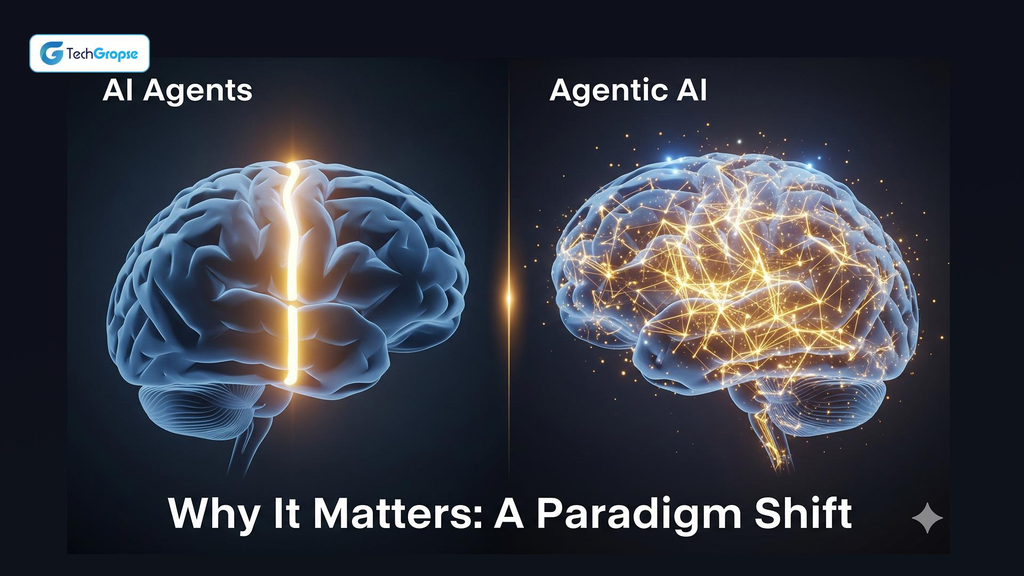
Agentic AI refers more broadly to an AI system’s ability to pursue goals through planning, reasoning, action, feedback, and adaptation. It can involve multiple specialized agents working together, dynamic task decomposition, persistent memory, and orchestration.
For instance, an Agentic AI system handling a marketing campaign might divide a larger objective into several activities. One agent could research competitors, another could analyze customer data, another could create content, and another could evaluate campaign performance.
The 2026 academic review describes Agentic AI as an evolution toward coordinated systems with greater autonomy, dynamic planning, persistent memory, and collaboration between specialized agents.
Agentic AI vs AI Agents: Key Differences
| Feature | AI Agents | Agentic AI |
| Meaning | Individual AI software entities | Broader AI architecture or approach |
| Scope | Usually task or workflow focused | Can manage complex, multi-step objectives |
| Planning | Task-level planning | Dynamic, broader planning |
| Collaboration | May operate independently | Can coordinate multiple agents |
| Memory | Often limited to a task/session | May use persistent or shared memory |
| Tools | Uses selected tools | Can orchestrate multiple tools and agents |
| Complexity | Suitable for defined workflows | Suitable for complex, changing workflows |
| Example | Customer-support agent | Multi-agent business automation system |
These distinctions are conceptual rather than universal industry standards; terminology continues to evolve, and some organizations use the terms differently. The OECD’s 2026 work specifically notes the need for clearer definitions because agentic AI and AI-agent terminology is still developing.
How They Work Together
The easiest way to understand the relationship is to think of an AI agent as a worker and Agentic AI as the broader system that can organize workers.
A single AI agent might be responsible for researching a topic. In an Agentic AI workflow, that research agent could work alongside writing, analysis, verification, and reporting agents. An orchestration layer can assign sub tasks, coordinate outputs, and help the system work toward a larger objective.
This makes Agentic AI particularly relevant to complex business processes where several steps need to be completed rather than simply generating one response.
Real-World Applications
Both technologies can support applications such as:
- Customer service: handling inquiries and resolving routine issues
- Software development: assisting with coding, testing, debugging, and documentation
- Marketing: researching audiences, generating content, and analyzing campaigns
- Finance: gathering information and supporting research workflows
- Healthcare: assisting with information processing and decision-support workflows
- Business operations: coordinating repetitive multi-step processes
- Research: collecting information, analyzing results, and preparing reports
Research literature also identifies applications ranging from customer support and scheduling for individual agents to research automation, robotics coordination, and complex decision-support systems for Agentic AI.
Challenges and Risks
Greater autonomy also creates additional risks. AI systems can produce incorrect information, make unsuitable decisions, misuse tools, or behave unexpectedly. Multi-agent systems introduce additional challenges such as coordination failures and emergent behavior.
Security is another important consideration. Recent industry developments have focused on sand boxing, monitoring, identity controls, and mechanisms that can stop autonomous systems from taking unauthorized actions.
For this reason, organizations deploying autonomous AI should establish clear permissions, monitoring, human oversight, testing, and safeguards before allowing agents to perform consequential actions.
Conclusion
The main difference between Agentic AI vs AI Agents is their level of abstraction. An AI agent is generally a specific software entity designed to perform tasks, while Agentic AI describes a broader approach to building AI systems capable of autonomous, multi-step goal pursuit and potentially coordinating multiple agents.
As AI systems become more capable of planning, using tools, remembering context, and coordinating workflows, understanding this distinction can help businesses choose an architecture that matches the complexity of their requirements.