What Is ZipTie AI Search Analytics?
Businesses may learn how their brand, website, and content show up in AI-generated responses by using ZipTie AI Search Analytics, an AI search visibility and monitoring tool. ZipTie examines how AI search engines like ChatGPT, Google AI Overviews, Perplexity, Microsoft Copilot, Bing AI Overview, Google AI Mode, and Google Gemini mention, cite, and define a brand rather than only concentrating on standard Google rankings.
The Operation of ZipTie AI Search Analytics
Businesses can use ZipTie to develop projects and keep an eye on particular queries or prompts that prospective clients might pose to AI search engines. Important visibility indications, such as brand mentions, website citations, sentiment, and rival recommendations, are captured and analyzed. Daily, weekly, or monthly monitoring can be planned.
This is helpful as AI-generated search results have the potential to alter how consumers find companies. A business may show up less frequently in AI-generated results but perform well in traditional search results. For this new search environment, ZipTie offers an additional layer of visibility data
Important ZipTie Features
1. Monitoring AI Visibility
ZipTie keeps track of whether a brand shows up in AI-generated answers to pertinent inquiries.
2. Monitoring Citations
When AI engines use web pages as sources in their responses, the platform detects this. This can assist SEO teams in identifying information that is regarded as authoritative or helpful.
3. Monitoring Brand Mention
Companies may view the frequency with which their brand appears in monitored AI responses.
4. Analysis of Sentiment
ZipTie examines captured AI responses to determine whether a brand is portrayed favorably, neutrally, or unfavorably.
5. Analysis of Competitors
In order to determine which businesses show up in AI responses for similar themes and cues, users can keep an eye on rivals.
6. AI Success Score
ZipTie provides teams with a single statistic for tracking changes over time by combining citation, mention, and sentiment data into an AI Success Score.
The Significance of AI Search Analytics
Rankings, impressions, clicks, backlinks, and organic traffic are frequently the main focus of traditional SEO platforms. Another visibility layer is introduced by AI search: whether an AI system uses your website as a source or mentions your business when responding to a user’s query.
An AI engine might be asked, for instance, “What are the best AI SEO tools for monitoring brand visibility?” A different kind of search visibility than a traditional Google ranking is provided if your business is frequently discussed or referred to in responses to pertinent questions.
Instead of depending on sporadic manual searches, ZipTie assists teams in systematically monitoring this behavior.
ZipTie for Content Teams and SEO
ZipTie data can be used by SEO experts to find content opportunities. There may be a need for content analysis and optimization if competitors are regularly quoted for a certain topic but your website is infrequently mentioned.
Additionally, ZipTie offers historical measures and prompt-level performance data, enabling organizations to evaluate AI-search visibility across time and across several engines.
ZipTie vs. Traditional SEO Analytics
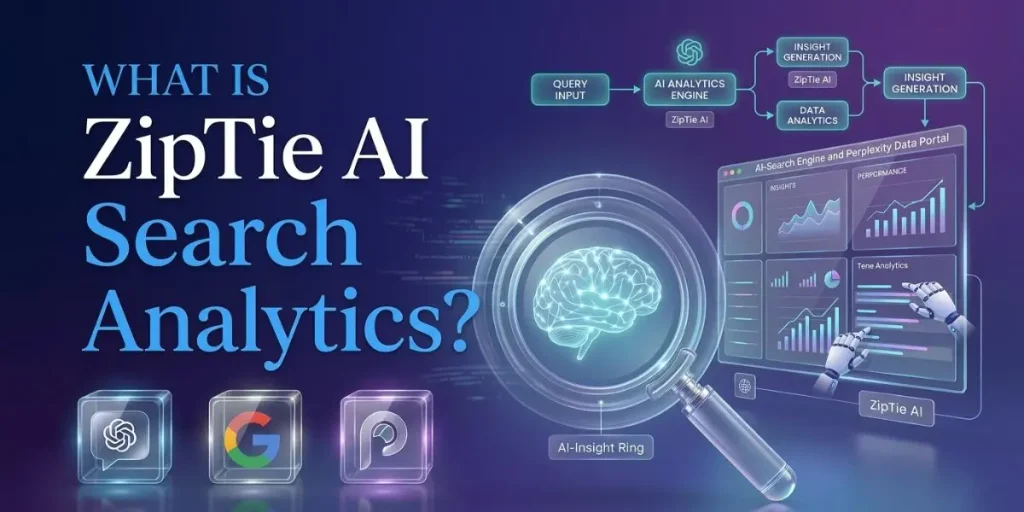
The main difference is the type of search behavior being measured:
- Traditional SEO: rankings, clicks, impressions, backlinks, and organic traffic.
- AI search analytics: AI mentions, citations, sentiment, competitors, and AI-generated answers.
- ZipTie: focuses specifically on monitoring and analyzing how AI search engines represent a brand and its website.
It is therefore better understood as a complement to traditional SEO analytics rather than a replacement for tools such as Google Search Console. ZipTie itself integrates Search Console data alongside AI-search information.
Conclusion
ZipTie AI Search Analytics is designed for the growing AI search optimization (AIO) landscape. It gives brands a way to monitor how they appear across major AI search engines, identify citations and mentions, compare their presence with competitors, and track changes over time. For SEO and content teams adapting to AI-generated search results, this type of data can help connect content optimization efforts with visibility inside AI answers.