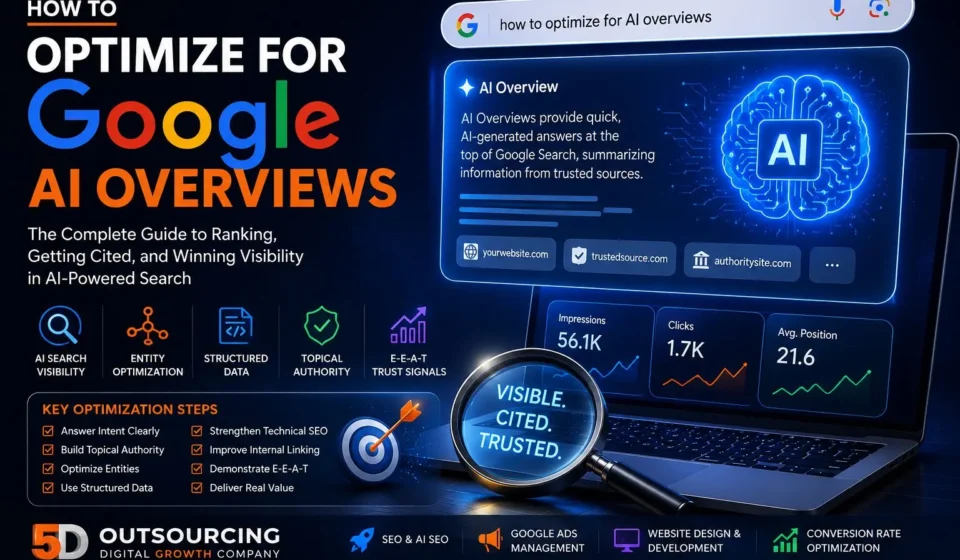

Google AI Overviews SEO are changing how users discover information in Search by providing AI-generated summaries with links to relevant webpage’s. For SEO professionals and website owners, this creates a new opportunity to improve visibility beyond traditional blue-link rankings. Google’s current guidance emphasizes that traditional SEO best practices still matter for generative AI features, while unique, useful, non-commodity content can help websites become more visible in AI-powered Search.
What Is AI Overviews SEO?
AI Overviews SEO is the process of optimizing website content so that it can be understood, discovered, and potentially referenced by Google’s AI-powered Search experiences. Unlike traditional SEO, where the primary goal is often ranking a webpage’s for a specific keyword, AI search can consider a broader range of information and user questions.
Google says AI Overviews and AI Mode use its existing Search and ranking systems, meaning websites should continue following fundamental SEO practices such as creating useful content, making pages crawl able, and clearly organizing information.
Why AI Overviews Matter for SEO
AI Overviews can appear for complex searches and provide users with summarized information alongside links to supporting websites. Google has also increased the number of links shown within its AI Search experiences, giving websites opportunities to receive visits from users who want to explore a topic further.
This means SEO strategies increasingly need to address both traditional search rankings and AI-driven discovery.
How to Optimize Content for AI Overviews SEO
1. Create helpful, original content
Avoid publishing generic articles that simply repeat information already available elsewhere. Google’s updated guidance specifically highlights the importance of unique, non-commodity content.
Add original explanations, examples, research, comparisons, statistics, expert insights, and practical recommendations where appropriate.
2. Match search intent
Understand what users actually want when they search for a topic. Content should directly answer informational, commercial, navigational, or transactional questions.
For example, instead of targeting only “AI SEO,” an article could address related questions such as:
What is AI SEO?
How does AI SEO work?
How do AI Overviews affect SEO?
How can websites appear in AI Search?
What are the best AI SEO practices?
3. Use clear content structure
Organize articles with descriptive headings, short paragraphs, lists, tables, examples, and direct answers. A logical structure makes content easier for both users and search systems to understand.
4. Strengthen topical coverage
Build comprehensive coverage around your primary topic rather than relying on one keyword repeatedly. Related concepts and naturally connected questions can demonstrate that a page provides substantial information about a subject.
5. Follow technical SEO fundamentals
Make sure Google can crawl, render, and index your pages. Use descriptive titles, proper headings, internal links, canonical URLs, mobile-friendly layouts, and appropriate structured data. Google continues to emphasize that established SEO practices remain relevant to generative AI Search.
6. Use structured data where appropriate
Structured data can help Google understand page content and may support eligible Search features. However, structured data should accurately represent the visible content rather than being used as a shortcut for AI Overview visibility.
7. Add original images and other useful media
Google’s updated guidance also discusses high-quality images and video as part of creating useful pages for generative AI Search. Visual content can make an article more useful while providing additional context around the subject.
AI Overviews and Traditional SEO
AI Overviews do not mean traditional SEO is obsolete. Google explicitly states that its generative AI Search features are based on core Search ranking and quality systems. Therefore, keyword research, technical SEO, internal linking, content quality, authority, and user experience continue to be important.
The main difference is that search journeys can now involve more complex and conversational queries. Google says users are asking longer and more complex questions with AI-powered Search, creating additional opportunities for relevant websites to be discovered.
AI Overviews SEO Measuring AI Search Performance
Website owners should monitor Google Search Console and their overall organic-search performance. Google has clarified that AI Overviews are included in Search Console’s Performance reporting methodology, so SEO teams can use Search Console alongside analytics tools to evaluate changes in impressions and clicks.
Final Thoughts
AI Overviews SEO is best approached as an extension of strong SEO rather than a completely separate optimization system. Websites should focus on original, useful, well-structured content that satisfies user intent and follows Google’s technical and quality guidelines. As AI-powered Search continues to evolve, businesses that consistently provide valuable information and make their content accessible to search engines can create more opportunities for visibility and qualified traffic.