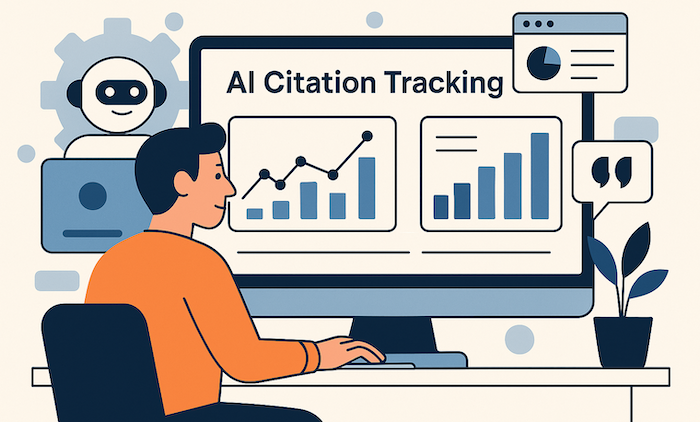

AI Citation Tracking is becoming an important part of modern SEO and Generative Engine Optimization (GEO). As users increasingly ask AI-powered search tools questions, businesses need to understand not only where their websites rank in traditional search, but also whether AI systems mention or cite their content.
AI citation tracking focuses on monitoring which websites and URLs are referenced by AI-generated answers, including platforms such as ChatGPT, Google AI Overviews, Gemini, Perplexity, and other AI search experiences.
What Is AI Citation Tracking?
AI Citation Tracking is the process of monitoring when and how AI search engines use a brand’s website or content as a source. A brand mention simply means that an AI response names a company or website, while a citation generally means the AI response attributes information to a specific source or URL.
For example, if someone asks an AI search engine, “What are the best AI SEO tools?” and the response includes your company with a link to one of your pages, that interaction can be recorded as an AI citation.
Why AI Citation Tracking Matters
Traditional SEO tools primarily measure rankings, organic traffic, backlinks, and other search metrics. AI citation tracking provides another layer of visibility by showing how a brand appears inside AI-generated responses.
It can help businesses discover:
- Which AI platforms mention their brand
- Which pages are being cited
- Which search prompts trigger citations
- How often competitors are cited
- Which content receives AI visibility
- Whether citation visibility changes over time
Some AI visibility platforms also track share of voice, citation position, sentiment, and competitor presence.
AI Citation vs. AI Mention
These two metrics should not be treated as identical.
AI Mention: The AI-generated response mentions your brand but does not necessarily link to your website.
AI Citation: The AI system references a specific source, often with a URL, as supporting information for its response.
Tracking both can provide a clearer picture of brand visibility because a business can be mentioned without receiving a source citation.
How AI Citation Tracking Works
A typical AI citation tracking workflow starts by identifying the questions that matter to a business. These can include informational, comparison, product, service, and “best” queries.
For example:
What is the best AI SEO software?
How does AI search optimization work?
What are the best tools for tracking AI visibility?
AI SEO agency vs traditional SEO agency
How can businesses improve AI search visibility?
The selected prompts are then tested across supported AI search platforms. The resulting answers are analyzed to determine whether the brand appears, which URLs are cited, and how competitors appear for the same questions.
Important Metrics to Track
A useful AI citation tracking strategy can monitor several metrics:
Citation Rate
Measures how frequently your website is cited across a defined set of prompts.
Mention Rate
Measures how frequently your brand appears in AI-generated responses, whether or not a URL is attached.
Citation URLs
Shows exactly which pages from your website are being referenced. This can help identify content that AI systems find useful.
Share of Voice
Compares your brand’s AI visibility with competitors across the same questions.
Citation Position
Records where your brand or source appears within an AI response or source list.
Visibility Trends
Tracking results over weeks or months can reveal whether AI visibility is increasing, decreasing, or changing between different AI platforms.
How to Improve AI Citation Opportunities
AI citation tracking is most useful when it leads to content improvements. Businesses can focus on creating original, well-structured, factually useful content that clearly answers important questions.
Consider:
- Create comprehensive topic-focused content
- Answer specific user questions clearly
- Use descriptive headings and logical content structure
- Include original research, examples, and useful data
- Strengthen internal linking between related pages
- Keep important information easy to understand and verify
- Build authoritative third-party references and brand mentions
- Monitor which pages are already receiving AI citations
Citation tracking should complement traditional SEO rather than replace it. AI visibility and conventional search visibility measure related but different aspects of how people discover information online.
The Future of AI Citation Tracking
As AI-powered search develops, citation tracking can become an important measurement layer for SEO teams. Instead of focusing exclusively on traditional keyword positions, marketers can also examine how their brands and content are represented in AI-generated answers.
The key is to track specific prompts, platforms, URLs, competitors, and trends rather than relying on a single AI visibility score. AI responses can change between platforms and over time, so consistent measurement provides more useful context.
Conclusion
AI Citation Tracking helps businesses understand how AI search systems discover, reference, and present their content. By monitoring citations, mentions, source URLs, competitors, and visibility trends, SEO professionals can identify content opportunities and better understand their presence in the growing AI search ecosystem.