
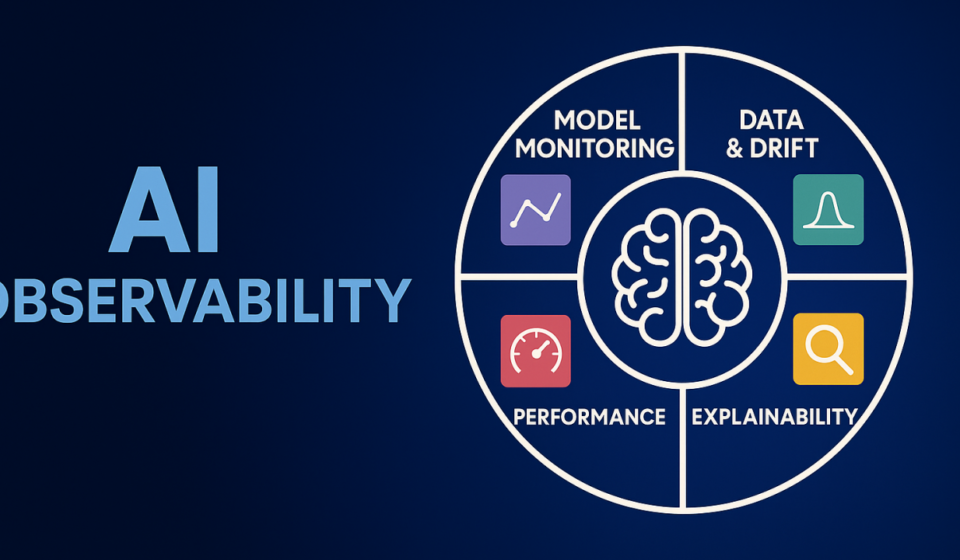

Modern AI operations increasingly depend on AI observability. As companies employ generative AI, machine learning models, AI agents, and automated workflows more frequently, they require improved methods to comprehend how these systems function, why they malfunction, and how they impact business results.
Metrics like up time, CPU use, latency, and errors are the primary focus of traditional program monitoring. By looking at model behavior, data quality, outputs, performance, costs, and user interactions, AI observability goes one step further.
What Is AI Observability?
The process of gathering, evaluating, and tracking data from AI and machine learning systems in order to comprehend their internal behavior and overall performance is known as AI observability.
It assists development and operational teams in responding to crucial queries like:
- Why did an AI model generate a wrong response?
- Does the model’s accuracy decrease with time?
- Are hallucinations being produced by AI responses?
- What is the price of each AI request?
- Which workflows or prompts lead to failures?
- Does the model react fast enough?
- Does performance change when input data is altered?
- Are tasks being successfully completed by AI agents?
Observability enables businesses to spot errors before they become significant business concerns by offering visibility throughout the full AI pipeline.
The Significance of AI Observability
Because AI systems’ outputs can rely on shifting data, prompts, models, context, and external tools, they are more unpredictable than traditional software.
For instance, a chatbot may function properly during testing but start giving incorrect responses after its knowledge base is updated. It can be challenging to determine the reason in the absence of observability.
AI observability offers ongoing insight into:
Accuracy, latency, dependability, and other performance metrics are monitored by the model.
Data quality: Identifies anomalous, inconsistent, out-of-date, or missing data.
Output quality: Assists in identifying responses produced by AI that are hazardous, prejudiced, irrelevant, or wrong.
Cost management: Keeps tabs on model costs, infrastructure costs, token usage, and API consumption.
Security: Assists in identifying anomalous conduct, dubious inputs, early injection attempts, and illegal activity
Key Components of AI Observability
1. Model Observation
After an AI system is deployed, model monitoring monitors its performance. Accuracy, precision, recall, latency, throughput, and error rates are examples of significant measurements.
Model drift, which happens when real-world data changes and the model’s performance deteriorates, can also be detected through monitoring.
2. Observability of Data
High-quality data is essential to AI. Data observability keeps an eye on the data entering pipelines and models.
It is able to recognize:
- Absence of data
- Records that are duplicates
- Unexpected values
- Modifications to the schema
- Changes in the distribution of data
- Outdated data
Organizations can maintain dependable AI outputs with improved data visibility.
3. Observability of LLM
Additional monitoring requirements are introduced by large language models. Prompts, answers, token consumption, latency, model versions, and workflow traces may all be monitored with LLM observability.
Teams can utilize this data to look into the reasons behind a specific response and identify areas that want improvement.
4. Observability of AI Agents
AI agents frequently communicate with databases, models, a pis, and various tools. Because of this, it is more challenging to keep an eye on their conduct than a straightforward chatbot.
Agent observability offers insight into:
User request → AI workflow/reasoning → tool calls → external systems → final answer
Developers can use this trace to pinpoint the precise location of an agent’s failure.
5. Monitoring AI Costs
When used extensively, AI can become costly. API calls, token consumption, infrastructure utilization, and expenses by application, model, team, or client can all be monitored using observability systems.
This enables businesses to find costly processes and choose the best model.
AI Observability’s Advantages

Quicker Troubleshooting
When an AI system malfunctions, thorough logs and traces enable developers to identify the issue more quickly.
Enhanced AI Precision
Teams can find reoccurring mistakes and enhance models, prompts, retrieval systems, or datasets by keeping an eye on output quality.
Improved User Experience
Organizations may produce AI applications more quickly and dependably by monitoring latency, unsuccessful requests, and answer quality.
Lower Expenses
Businesses can find costly workflows, ineffective prompts, and pointless model calls.
More Robust AI Governance
Establishing accountability and compliance procedures is made simpler by observability, which offers proof of how AI systems function.
AI Observability in Comparison to Conventional Monitoring
Conventional monitoring typically inquires about the functionality of a system.
AI observability inquires as to whether the system is operating properly and yielding meaningful outcomes.
An API might have 99.9% up time, for instance, but its AI responses are getting more and more erroneous. While AI observability can show the decline in output quality, traditional monitoring may indicate everything as healthy.
AI Observability Best Practices
Establishing crucial performance and quality criteria should be the first step for companies using AI observability. After that, a centralized system should be used to gather logs, traces, model metrics, data-quality signals, and user comments.
Setting up notifications for major issues like odd latency, abrupt accuracy declines, growing expenses, model drift, security risks, or increased hallucination rates is also crucial.
Businesses shouldn’t just keep an eye on technical metrics. Business results are also important. For instance, an AI sales assistant should be assessed based on lead quality, conversion rates, client happiness, and response time.


