


Decision Intelligence is a set of data science, artificial intelligence, business intelligence, and decision theory used to enhance how companies make decisions. It uses artificial intelligence (AI) to forecast and recommend the best course of action rather than only analyzing historical performance.
The phrase gained popularity in 2018 when Google began referring to parts of its data science initiatives as “decision intelligence,” emphasizing analytics that allow for real decisions rather than just reporting facts. In order to generate insights and make more intelligent strategic decisions, modern decision intelligence systems integrate data from departments like marketing, finance, and operations.
The Operation of Decision Intelligence
In its most basic form, artificial intelligence, decision modeling, and data are the three essential components of decision intelligence technology.
It is a procedure that is often carried out in an organized workflow:
Information Acquisition and Integration
Numerous systems, including CRM programs, financial systems, marketing programs, and operational databases, are used to gather data. This offers a shared data environment.
Artificial Intelligence and Advanced Analytics
To find patterns, anomalies, and trends, the data is examined utilizing augmented analytics and machine learning models.
Modeling Decisions
Business regulations, financial ramifications, and operational constraints are used to interpret insights in practical contexts.
Scenario modeling and forecasting
Leaders can evaluate possibilities and risks before making a decision by using artificial intelligence models to create scenarios.
Practical Suggestions
Dashboards are not displayed by decision intelligence software; instead, it makes recommendations for actions based on the projected outcomes.Organizations are able to go beyond simple analytics and intelligent decision systems because to this combination
The Three Intelligence Decision Modes
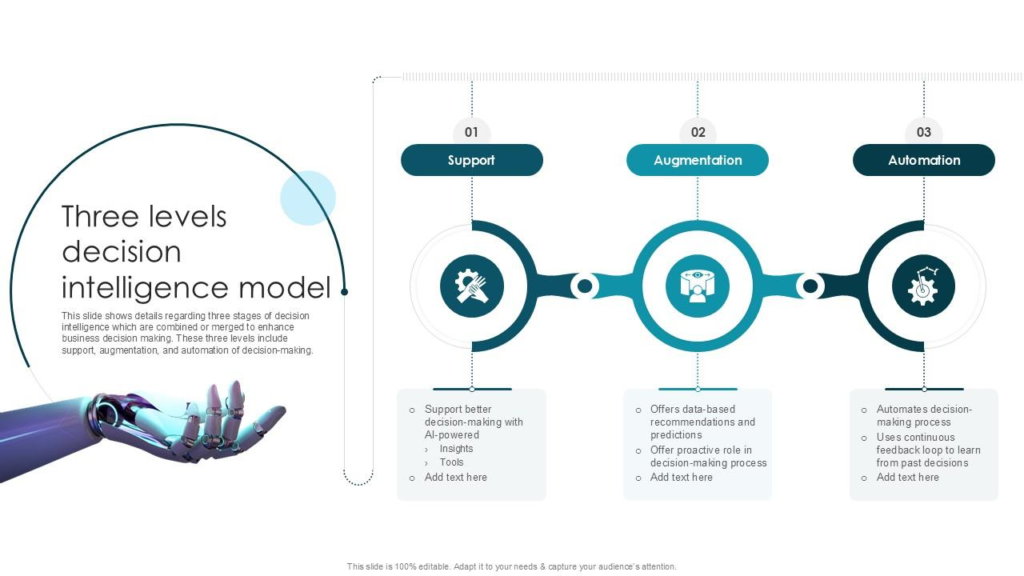
According to a Kellton investigation, businesses that use AI-driven decision technology can increase and speed up decision-making by up to 30%. As a result, many companies are using decision intelligence systems to support, enhance, and automate critical business decisions.
Decision intelligence systems typically operate at three levels of interaction.
1. Assistance in Making Decisions
At this level, leaders are still in charge of making the final choice, but AI provides information and data analysis to enable humans to make better decisions.
2. Augmenting Decisions
In this instance, AI makes recommendations based on predictive models. Humans evaluate and approve these suggestions.
3. Automation of Decisions
In highly organized environments, algorithms can be used to make decisions automatically. Examples include dynamic pricing systems and automated fraud detection systems. These modalities allow businesses to gradually incorporate AI decision intelligence into their operations.
What’s the difference between Decision Intelligence and artificial intelligence (AI)?
Artificial Intelligence (AI) is the theory and development of algorithms that can carry out tasks that have historically only been performed by humans, like language processing, decision making, and visual perception. On the other hand, decision intelligence is a useful use of AI that focuses on business decision-making.
It offers suggested courses of action that meet a particular business requirement or resolve a particular business issue. Business decision-making at scale for companies in a variety of industries is powered by decision intelligence, which is always commercially focused.
An AI could be, for instance, an algorithm that can forecast future demand for a particular group of goods. But it doesn’t truly become “Decision Intelligence” until a marketing team can utilize an interface to make purchasing and stock management decisions based on this initial AI-powered .
Challenges And Limitations Of Decision Intelligence
The application of decision intelligence is not without its difficulties, despite its benefits.
Problems with Data Quality
When data sources are incomplete or inaccurate, AI models may produce unreliable insights.
Complexity of Implementation
There is a lot of technical system integration involved in a complete DI infrastructure.
Culture of the Organization
Some firms find it difficult to adopt data-driven decision-making processes, especially when management is still using outdated procedures or intuition.
Gaps in Skills
Teams must have expertise in AI, analytics, and decision modeling in order to fully employ DI solutions.
Good leadership, data governance, and a distinct strategic vision are the answers to these problems.
Intelligent Decision-Making’s Future
The ability to convert information into intelligent actions has become one of the competitive advantages as businesses generate ever-increasing amounts of data. Decision Intelligence is the next set of analytics that focuses on decisions rather than data.
By using AI decision intelligence, the company will be able to make more accurate judgments, gain deeper insights into its operations, and confidently navigate uncertainty. The amount of data that businesses get will vary, but how well they use it to make decisions will determine how successful they are.


