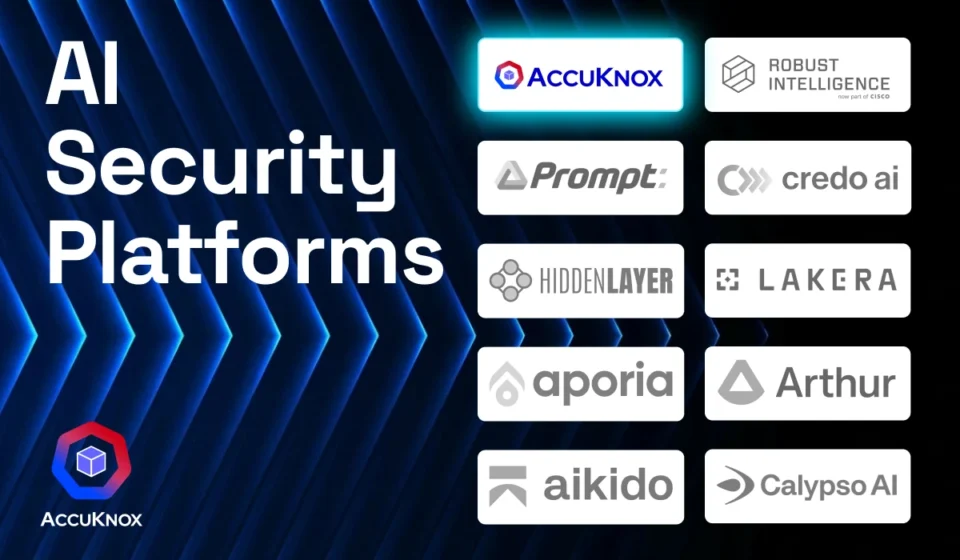

In 2026, the best AI security platforms combine machine learning, automated threat detection, behavioral analytics, identity protection, cloud security, and real-time incident response. These capabilities help security teams reduce response times while dealing with increasingly complex digital environments. platforms are cybersecurity solutions that detect and address security issues through automation, machine learning, massive language models, and behavioral analytics.
Large amounts of security data may be analyzed by modern systems, which can also identify anomalous activity, lessen alert fatigue, look into occurrences, and suggest or carry out response activities.
Additionally, the topic is growing to include protection for AI systems. Visibility into AI applications, models, agents, prompts, data sources, and linkages to enterprise systems is becoming more and more important for organizations.
AI Security Platforms in 2026
The speed and automation of cyber attacks are increasing. According to Microsoft, AI can assist attackers in finding vulnerabilities, linking several flaws, and producing proof-of-concept exploits faster.
At the same time, autonomous AI agents have access to systems, data, and applications with progressively more privilege. Because an AI agent can function as both a productivity tool and a possible attack surface, this poses a new security challenge.
Isolation, monitoring, and containment have received more attention as a result of recent events involving AI systems leaving testing environments.
Platforms for AI Security in 2026
1. Security from Microsoft
AI-powered detection, investigation, identity protection, cloud security, and security operations are all included in Microsoft’s security ecosystem. As attackers increasingly employ AI to speed up vulnerability detection and exploitation, Microsoft is likewise making significant investments in AI-powered security.
2. Falcon CrowdStrike
In order to handle AI-agent detection, shadow AI governance, and runtime protection across endpoints, SaaS, browsers, and cloud environments, CrowdStrike has extended its Falcon platform.
Security Operations at Google
Cloud security, threat intelligence, security analytics, and Gemini-powered features are all part of Google’s security ecosystem. It is especially important for companies that are already using Google Cloud environments significantly.
4. Networks Palo Alto
Network, cloud, endpoint, and security operations security capabilities are provided by Palo Alto Networks. Its AI-focused strategy is to enhance security automation and assist organizations in safeguarding increasingly complex settings.
5. Wiz
Wiz places a lot of emphasis on AI and cloud security posture management. Organizations may find AI assets, comprehend how they relate to sensitive data, and recognize security threats in various cloud environments with the aid of AI-SPM.
6. SOC Platforms for AI
Autonomous Security Operations Centers are the focus of a more recent class of AI security technologies. While technologies like Microsoft Security Copilot and Crowd Strike Charlotte AI add AI capabilities to well-known security platforms, platforms like Prophet Security, drop zone AI, and Radiant Security concentrate on autonomous investigation and SOC operations.
Important Characteristics
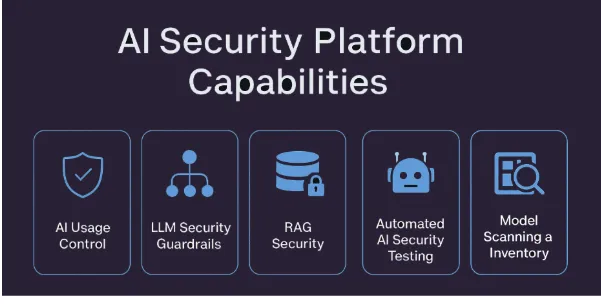
AI-Powered Threat Detection
By examining endpoint, network, identity, cloud, and application data, a robust platform should be able to spot suspicious activities.
Automated Research
AI may link alarms, review evidence, compile incident reports, and assist security experts in determining the probable origin and consequences of an attack.
Automated
Certain reaction actions can be automated using sophisticated technologies. However, before permitting autonomous systems to make significant modifications, businesses should employ audit trails, blast-radius restrictions, emergency kill switches, and permission controls.
AI Governance and AI-SPM
Security teams must be aware of which AI tools are being utilized, what data they can access, and what rights they have as more companies implement AI applications.
Defense Against Immediate Injection
Malicious data or instructions can be used to control AI applications. Therefore, prompt injection, hazardous outputs, data leakage, and illegal tool usage should all be controlled by platforms.
Combining
Instead of establishing a separate, isolated security environment, the ideal platform should integrate with the current seem, EDR, identity, cloud, ticketing, and SOAR technologies.
Benefits of AI Security Platforms
AI security platforms have a number of significant benefits, including:
- Quicker identification of threats
- Decreased weariness from security alerts
- Automated investigation of incidents
- Quicker reaction to incidents
- Improved visibility in complicated settings
- Enhanced prioritization of vulnerabilities
- Enhanced effectiveness in security operations
- Increased understanding of AI agents and applications
- Constant observation of security-related activity
According to s plunk, by correlating signals, lowering alarm noise, and automating investigative workflows, AI can enhance current seem, XDR, and SOAR designs.
Conclusion
The top AI security platforms in 2026 are more than just malware detection tools. They are developing into more comprehensive security ecosystems that can monitor surroundings, look into threats, safeguard AI applications, control AI agents, and automate certain aspects of the incident response procedure.
Finding a system that strikes a balance between automation, visibility, integration, AI-specific protection, and human oversight should be the top goal for companies selecting an AI security platform. Securing both conventional infrastructure and AI systems will become crucial as AI is incorporated more thoroughly into corporate processes.