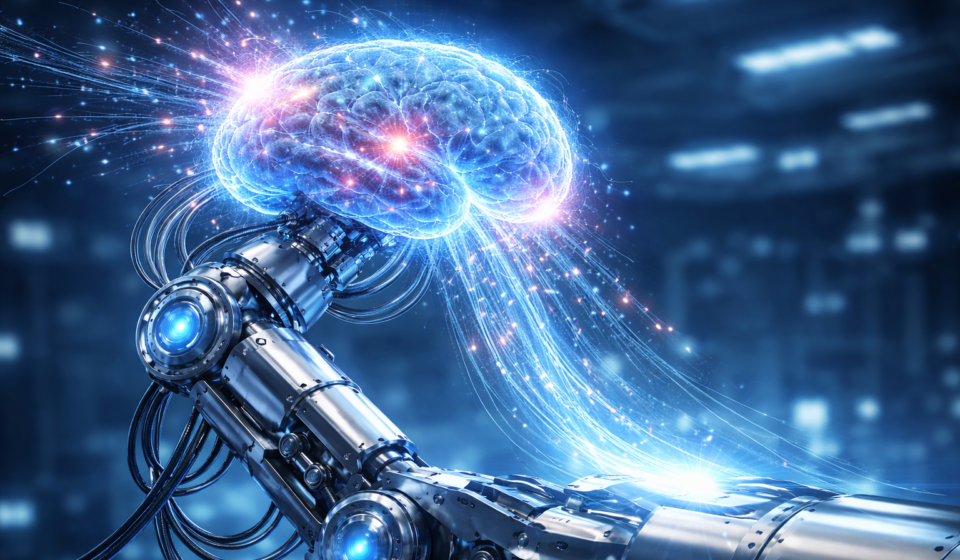

Physical AI Overview:
Artificial intelligence with the ability to see, comprehend, decide, and act in the real environment is known as physical AI. Physical AI links intelligent models with physical machinery like robots, autonomous cars, drones, industrial equipment, and smart gadgets, in contrast to standard AI systems that primarily interact with text, images, software, or digital data.
The technology integrates real-time computing, sensors, cameras, actuators, control systems, and AI models. Instead of only obeying predetermined instructions, this enables machines to comprehend their environment and react to changing circumstances.
Physical AI Operate?
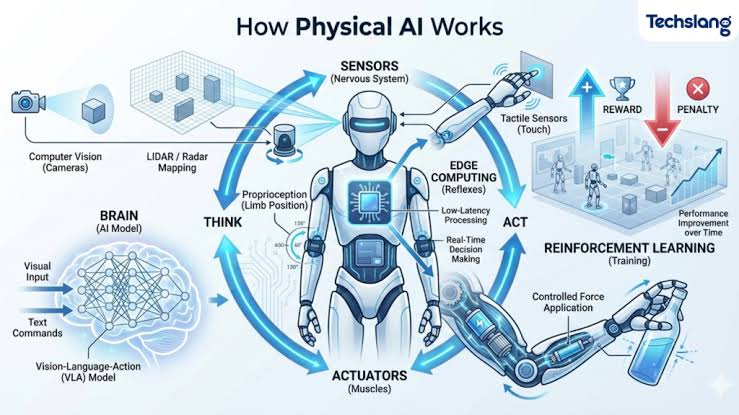
Physical AI often operates in an ongoing cycle:
- Perception: Cameras and sensors gather data about the surroundings.
- Understanding: AI models make sense of things, people, movement, distance, and other circumstances.
- Making decisions: The system assesses the circumstances and chooses the best course of action.
- Action: The choice is carried out by motors, robotic arms, wheels, or other actuators.
- Learning: Information from the outcome can be utilized to enhance performance in the future.
This method turns robots from inflexible, preprogrammed machines into more flexible systems that can react to changes in the actual world.
Physical AI’s Core Technologies
Computer vision, machine learning, reinforcement learning, simulation, digital twins, robotics, edge computing, and sophisticated sensors are some of the technologies that are accelerating physical artificial intelligence.
Because robots can rehearse tasks in virtual environments before executing them in the actual world, simulation is especially crucial. Machines may acquire movement, manipulation, navigation, and other physical skills with the use of training methods including imitation learning and reinforcement learning.
Another new method is vision-language-action models. These technologies enable robots to comprehend instructions and engage with their environment by linking visual perception and verbal comprehension with physical activities.
Physical AI Applications
Applications for physical AI can be found in numerous industries:
Production
Robots with AI capabilities may transport supplies, build goods, check parts, and adjust to changes in production lines.
Logistics and Storage
With reduced reliance on fixed programming, autonomous mobile robots can sort packages, move merchandise, and traverse warehouse environments.
Medical care
Medical robotics, hospital logistics, rehabilitation equipment, and other systems that need precise interaction with people and environments can all benefit from physical AI.
Farming
AI-enabled devices can assist with harvesting and other agricultural tasks, monitor crops, identify plants, and identify issues.
Self-Driving Cars
To comprehend roadways, identify things, and make driving judgments, self-driving cars employ cameras, radar, lidar, and artificial intelligence models.
Drones
Drones with AI capabilities can deliver items, monitor vast areas, examine infrastructure, and react to shifting environmental circumstances.
Robotics using Humanoids
One of the most prominent developments in physical AI is humanoid robots. The goal of recent developments is to enable robots to function in human-designed surroundings and carry out a variety of jobs.
Physical AI’s advantages
Adaptability is Physical AI’s greatest benefit. The same task is frequently carried out repeatedly under controlled circumstances using traditional automation. Physical AI may be able to react to unforeseen objects, shifting surroundings, and novel circumstances.
Additional advantages consist of:
- Increased productivity and automation
- Increased accuracy
- less exposure to risky activities
- More adaptable production
- Improved human-machine cooperation
- Making decisions in real time
- Assistance for labor-intensive sectors
Therefore, physical AI can support human workers by managing hazardous, physically taxing, or repetitive tasks while people concentrate on higher-level duties.
Physical AI’s Difficulties
Physical AI has a lot of obstacles to overcome despite its potential. Errors can have rapid repercussions in the real world because physical situations are unpredictable. Robots have to contend with physical forces, unexpected items, shifting surfaces, sensor faults, and safety regulations.
The sim-to-real divide presents another difficulty. When confronted with the complexity of the actual world, a robot may struggle even when it performs incredibly well in simulation. Large volumes of high-quality physical data are also needed for training, and deployment and sophisticated technology might be costly.
As physical AI spreads, other factors to take into account include safety, cybersecurity, privacy, legislation, energy usage, and human acceptance.
Physical AI’s Future
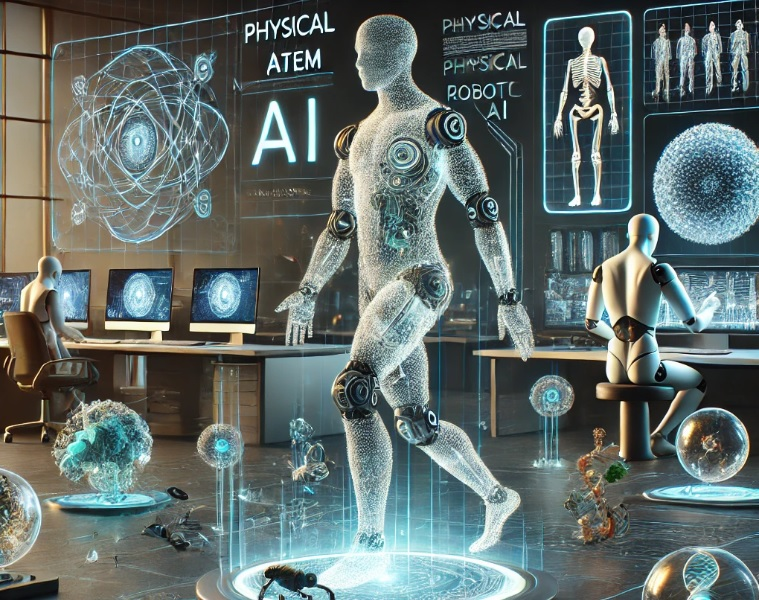
Because it extends artificial intelligence beyond digital settings and into the real world, physical AI is emerging as a significant next step in the field. In 2026, industrial robotics, autonomous machinery, humanoid robots, and AI systems that can learn from real-world experience will be the main areas of industry activity.
Physical AI may become more prevalent in industries, warehouses, hospitals, transportation, agriculture, and homes as sensors, robotics hardware, AI models, simulation, and computers continue to advance.