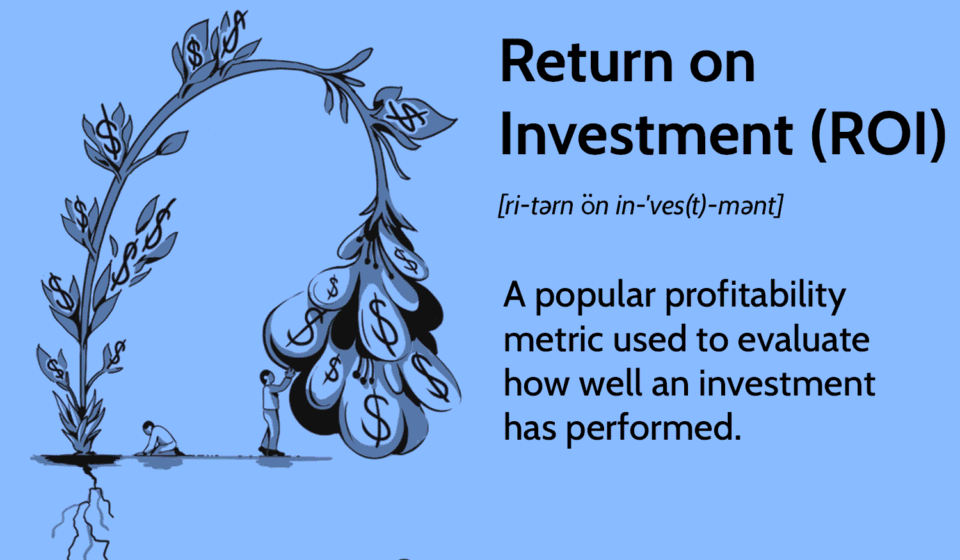

ROI (Return on Investment) is a financial metric used to measure how much profit or loss an investment generates compared with the amount of money invested. Businesses, investors, and individuals use ROI to evaluate whether an investment is producing a worthwhile return. In simple terms, ROI helps answer one important question: “How much did I gain compared with what I spent?”
What Does ROI Mean?
Return on Investment compares the financial return from an investment with its original cost. It is usually expressed as a percentage, making it easier to compare different investments.
For example, if you invest $1,000 in a marketing campaign and generate $1,300 in revenue attributable to that campaign, the investment produced a $300 return before considering other relevant costs.
A higher ROI generally indicates that an investment has performed better, while a negative ROI means the investment resulted in a loss.
How to Calculate ROI
The basic ROI formula is:
ROI = (Net Profit ÷ Cost of Investment) × 100
For example, suppose a business invests $5,000 in an advertising campaign and earns $7,000 in profit after accounting for the campaign’s costs.
ROI = ($7,000 ÷ $5,000) × 100
ROI = 140%
The exact calculation can vary depending on how an organization defines investment cost, revenue, and net profit. For meaningful comparisons, businesses should use consistent assumptions.
Why Is ROI Important?
ROI is important because it provides a straightforward way to evaluate financial performance. Companies can use it to compare different projects, marketing campaigns, equipment purchases, technology investments, and other business decisions.
For example, a company might compare the ROI of social media advertising with the ROI of search advertising. The results can help management determine where future resources should be allocated.
ROI can also help businesses:
- Measure investment performance
- Compare different opportunities
- Identify profitable activities
- Control unnecessary spending
- Support financial decision-making
- Evaluate marketing campaigns
- Set performance targets
ROI in Business
Businesses use ROI across many departments. In marketing, ROI can help determine whether a campaign generates enough financial value to justify its cost.
For technology investments, companies may evaluate whether new software reduces operating expenses, increases productivity, or generates additional revenue.
ROI can also be applied to employee training, new equipment, business expansion, and customer acquisition.
However, ROI should not always be the only factor considered. An investment with a lower immediate ROI could provide important long-term benefits, such as stronger customer relationships or improved brand recognition.
ROI in Marketing
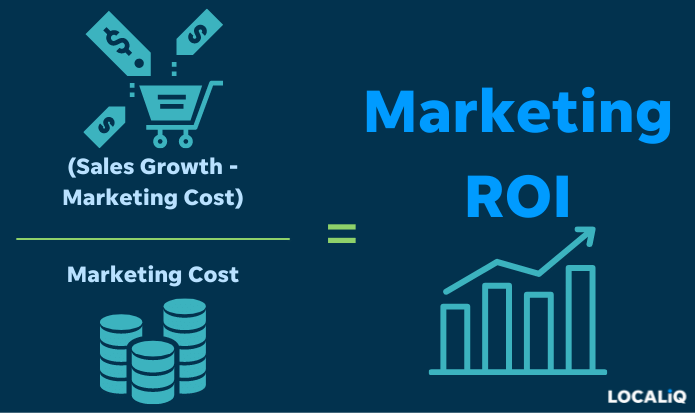
Marketing ROI is commonly used to evaluate the financial effectiveness of promotional activities. Businesses can compare the money spent on advertising with the revenue or profit generated from those efforts.
For example, an online store spends $2,000 on a campaign and generates $3,000 in net profit attributable to that campaign. Using the basic formula, the ROI would be:
($3,000 ÷ $2,000) × 100 = 150%
Accurate marketing ROI calculations should account for relevant costs rather than relying only on total sales revenue.
Limitations of ROI
Although ROI is useful, it has limitations. The basic formula does not automatically account for the length of time an investment is held. Two investments could have the same ROI but produce that return over very different periods.
ROI can also overlook factors such as risk, cash flow, inflation, opportunity cost, and intangible benefits.
For this reason, businesses often combine ROI with other financial metrics, such as net present value (NPV), internal rate of return (IRR), payback period, and cash-flow analysis.
Final Thoughts
ROI, or Return on Investment, is one of the most widely used metrics for evaluating financial performance. Its simple percentage-based formula makes it useful for comparing investments and understanding whether spending is generating an acceptable return.
However, ROI should be interpreted within context. Time period, risk, costs, cash flow, and long-term benefits can all affect whether an investment is truly worthwhile. By combining ROI with other financial measures, businesses can make more informed investment and budgeting decisions.