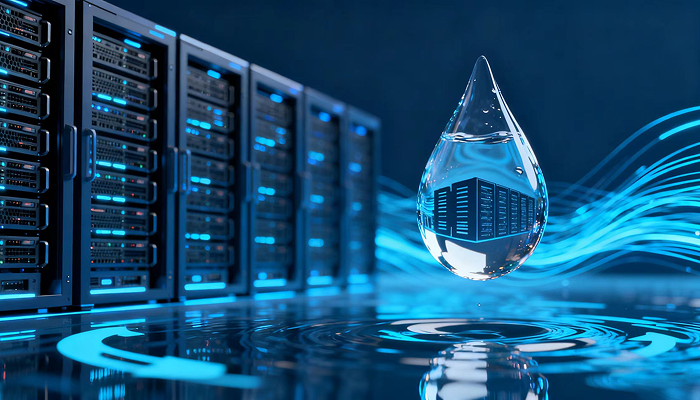

Artificial intelligence (AI), which powers chatbots, creates graphics, analyzes data, and supports cutting-edge research, is revolutionizing a number of industries. But these digital services are powered by massive data centers that need a lot of cooling and electricity. The subject of how much water artificial intelligence uses is one that is being debated more and more.
Since AI does not directly “drink” water, the answer is complex. Rather, water is mostly utilized in the production of computer hardware, the cooling of data center equipment, and the generation of some of the electricity that supports such establishments.
Why Is Water Used by AI?
Strong processors, especially GPUs and other specialized chips, fuel AI systems. It may need thousands of processors functioning nonstop to train and run huge models. These devices generate a significant quantity of heat.
To keep equipment from overheating, data centers need to evacuate this heat. Water-consuming cooling systems, especially evaporation cooling systems, are used in many locations. A portion of the heat absorbed by the water in these systems evaporates into the atmosphere.
As a result, the location of the data center, cooling technology, electricity source, weather, and workload all affect AI’s water footprint.
How Much Water Is Used by AI?
No single figure can be applied to all AI systems. The amount of water used by data centers and AI models can differ significantly.
According to research, depending on the location and method of training, a large AI model may indirectly use hundreds of thousands of liters of water. Billions of inquiries can have a substantial aggregate influence, while some estimates for individual AI encounters are far less.
Differentiating between water usage and withdrawal is crucial. In general, consumption refers to water that is not immediately returned to a source, such as water lost through evaporation, whereas withdrawal refers to water that is removed from a source.
AI Inference vs. AI Training
The two main phases of AI’s water use are training and inference.
The process of teaching an AI model using massive datasets is called training. Strong computer infrastructure that runs for days or weeks may be necessary. As a result, training a large model could require a significant amount of water and energy.
Every time a user engages with a trained model, inference takes place. Computing resources are needed to generate an image, ask a chatbot a question, or request an AI-powered analysis. The water footprint of a single request could be rather small, but the cumulative effect of billions of requests can be far more.
Inference could play a bigger role in the environmental impact of the industry as AI use rises.
What Determines How Much Water AI Uses?
The amount of water needed for an AI job depends on a number of factors:
Cooling technology: Compared to facilities that mostly use air cooling or closed-loop systems, data centers that use evaporation cooling may use more water.
Climate: Warm climates might need additional cooling, which could result in a rise in water use
Electricity source: Water may also be needed for power generation. For instance, water may be used for cooling in nuclear and fossil fuel power plants.
AI model size: While efficiency gains might lower resource consumption, larger models often demand more computational power.
Data-center efficiency: With improved hardware, infrastructure, and temperature control, modern facilities can increase energy and cooling efficiency.
Can AI Increase Water Efficiency?
Indeed. AI’s water impact is being investigated in a number of ways by tech firms and data center owners. Liquid cooling, closed-loop cooling systems, reclaimed water, enhanced chip efficiency, and data centers tailored to regional environmental conditions are some of these.
Efficiency can also be increased by AI itself. Cooling equipment may be optimized, maintenance needs can be anticipated, and needless energy use can be decreased with the aid of machine learning algorithms.
Additionally, some facilities are looking into areas with easier access to recycled or non-potable water and renewable energy.
AI’s Future and Water Use

Environmental concerns will become more crucial due to the quick development of generative AI. The demand for data-center capacity will keep rising as more people utilize AI assistants, search tools, picture producers, and commercial apps.
The crucial question is not just how much water artificial intelligence consumes, but also how well that water is managed. Better technology, prudent data-center development, effective cooling solutions, and transparent reporting can all help lessen the environmental impact of AI.
Conclusion
Water use is a significant component of the hidden environmental cost of artificial intelligence. Water is mostly used by AI for data center cooling, while it is also indirectly used in the production of hardware and electricity. Water efficiency is becoming more crucial due to the industry’s rapid growth, even if the amount varies greatly by model, facility, location, and technology.