The collection of programming languages, frameworks, libraries, databases, servers, cloud platforms, and development tools needed to create and manage a digital product is known as a tech stack. The proper tech stack is crucial for performance, security, scalability, and long-term development in everything from websites and mobile applications to SaaS platforms and AI-powered systems.
What is Tech Stack?
In essence, a tech stack is the technological underpinning of a digital product. It dictates how an application is created, how data is kept, how users engage with the system, and how the program interacts with other services.
There are two main sides to a typical application:
front-end: The area that users view and interact with.
back end: The server-side architecture in charge of data processing, authentication, business logic, and a pis.
The technology stack is completed by a database and auxiliary infrastructure.
Principal Elements of a Tech Stack
1. Front-end technologies
The user interface and user experience are produced by fronted technology. HTML, CSS, JavaScript, and contemporary frameworks like React, Angular, and cue are examples of common technology.
Fast loading, responsive design, accessibility, and a seamless user experience across devices are all characteristics of a successful fronted stack.
2. Technologies on the back end
Application logic, authentication, a pis, data processing, and inter-service communication are all handled by the back end.
Node.js, Python, Java, PHP, Ruby, and.NET are popular back end technologies. By offering reusable structures and development tools, frameworks help speed up development.
3. Information databases
Application data, including customer profiles, transactions, goods, content, and analytics, are stored in databases.
There are two main types of databases:
- MySQL, PostgreSQL, and Microsoft SQL Server are examples of relational databases.
- MongoDB, Redis, and other document or key-value systems are examples of NoSQL databases.
Data structure, performance needs, scalability, and application complexity all influence the decision.
4. integration’s and a pis
a pis facilitate communication between various services and applications. Payment systems, authentication services, maps, analytics platforms, AI models, and other external tools can all be connected via them.
Expanding and maintaining an application is made easier by a well-designed API layer.
5. Infrastructure and Cloud
Cloud infrastructure is frequently used by modern applications for networking, hosting, storage, monitoring, and scaling.
When demand increases, cloud platforms can let firms expand their processing capacity while lowering the requirement for physical infrastructure maintenance.
6. Development Tools and DevOps
Automated testing, deployment, monitoring, version control, and infrastructure management are all supported by DevOps tools.
Containers, automated testing, monitoring systems, CI/CD pipelines, and Git-based workflows can all increase the dependability and efficiency of development.
How to Select the Appropriate Tech Stack
The real needs of the project should be the first consideration when selecting a tech stack, not only popularity.
Take into account these elements:
Project requirements: Compared to a sophisticated SaaS platform, a basic website could need a somewhat lesser stack.
Scalability: Select technology that can accommodate expansion in the future without necessitating a total reconstruction.
Performance: Specialized infrastructure may be needed for applications with significant traffic or real-time functionality.
Security: From the start, it is important to take into account authentication, encryption, access control, dependency management, and frequent updates.
Developer expertise: The ability of the development team to use and maintain a technology makes it more valuable.
Budget: The overall cost is influenced by infrastructure, development, maintenance, licenses, and third-party services.
Community and ecosystem: Well-developed technologies frequently offer comprehensive documentation, libraries, developer support, and integration’s.
Examples of Popular Modern Tech Stacks
Different technology combinations are needed for different projects.
A JavaScript-based fronted, a Node.js or Python back end, PostgreSQL for structured data, cloud hosting, and automated deployment tools are all possible components of a contemporary web application.
Machine-learning frameworks, model a pis, vector databases, data-processing pipelines, and specialized cloud infrastructure can all be added to an AI application.
Native technologies like Swift or Kotlin, or cross-platform frameworks that let programmers create apps for several operating systems, can be used in mobile applications.
There isn’t just one “best” tech stack. The optimal option is the one that aligns with the technical specifications, business objectives, financial constraints, and anticipated expansion of the product.
A Well-Designed Tech Stack’s Advantages
A well-thought-out technological stack can offer the following benefits:
- Quicker creation and implementation
- Improved performance of applications
- Enhanced safety
- Simpler upkeep
- Increased scalability
- integration’s that are more dependable
- Reduced long-term development expenses
- Improved user experiences
The opposite issues, such as technical debt, sluggish development, costly maintenance, and difficulties scaling, might result from a poorly chosen stack.
2026 Tech Stack Trends
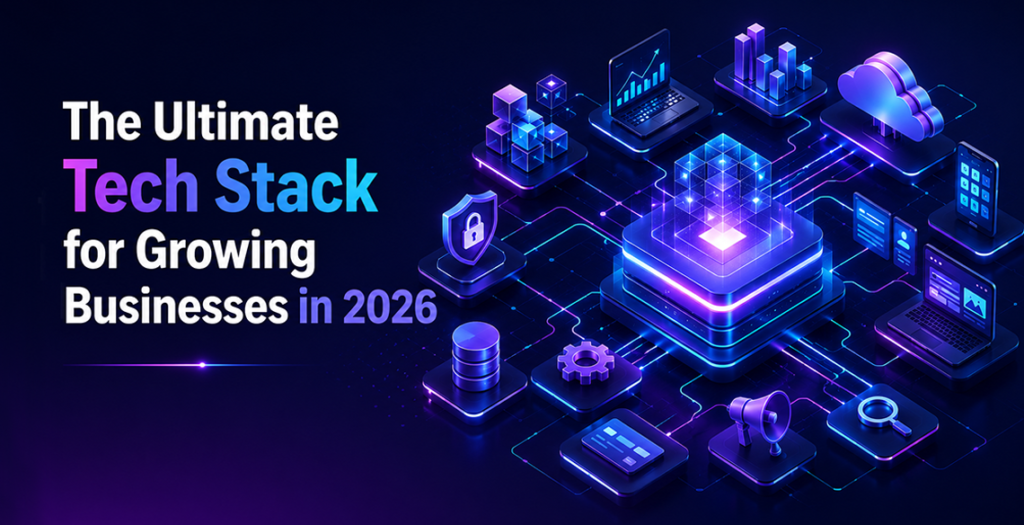
Artificial intelligence, cloud computing, automation, cybersecurity, and distributed architectures are all having an increasing impact on technology stacks. While cloud-native technologies continue to offer scalable apps, AI-assisted development tools are increasingly included into development workflows.
Additionally, organizations are prioritizing automated deployment, security, serviceability, and API-first development. Development teams are progressively assessing each technology’s entire ecosystem and long-term viability rather than just choosing popular technologies.
Concluding Remarks
A list of programming tools is only one part of a tech stack. A digital product’s construction, operation, security, and scalability are all determined by its technical base. The long-term viability of a project can be greatly impacted by the choice of fronted, back end, database, infrastructure, a pis, and development tools.
The newest or most complex technology stack is not always the strongest. It is a well-organized, safe, scalable, and maintainable set of technologies created with the particular requirements of the project in mind.