Artificial intelligence is changing the way militarism collect information, understand battlefields, plan operations, and coordinate forces. AI command in warfare refers broadly to the use of AI-enabled systems to support military command and control (C2), giving commanders faster access to information, predictions, simulations, and decision-support tools.
Modern military AI is generally not about replacing commanders with machines. Instead, the emerging model is human-machine teaming, where AI processes huge volumes of data while humans retain responsibility for important decisions. NATO, for example, emphasizes human responsibility, explain-ability, reliability, govern-ability, and compliance with international law.
What Is AI Command in Warfare?
Traditional command systems often require information to pass through multiple organizational layers before commanders can act. AI can shorten this process by combining information from many sources and presenting commanders with a rapidly updated operational picture.
The U.S. Department of Defense’s Combined Joint All-Domain Command and Control (CJADC2) concept illustrates this approach. It connects sensors, information systems, and command capabilities across tactical, operational, and strategic levels to improve decision speed and accuracy.
In simple terms:
Sensors → Data → AI Analysis → Decision Support → Human Commander → Action
The goal is to create what military planners often describe as decision advantage.
Major Applications of AI in Military Command
1. Battlefield Situational Awareness
AI can process information from numerous sources and help commanders build a clearer picture of changing conditions. Instead of manually reviewing every incoming data stream, AI systems can identify patterns, anomalies, and potentially important developments.
This is particularly valuable in environments where information arrives faster than humans can process it.
2. Intelligence Analysis
AI can assist intelligence teams by organizing large datasets and identifying relationships that could otherwise be difficult to detect.
Potential applications include:
- Processing large amounts of intelligence
- Identifying patterns
- Comparing historical information
- Supporting threat assessment
- Prioritizing information for human analysts
- Detecting anomalies
The objective is not simply to produce more information but to help commanders distinguish important information from noise.
3. Faster Decision Support
One of the biggest advantages of AI-enabled C2 is speed. AI can evaluate multiple possible scenarios and provide commanders with decision-support information much faster than traditional manual processes.
A 2026 U.S. Army Research Laboratory report describes AI-integrated C2 as a shift toward more dynamic operational processes in which AI and human expertise work together to improve planning, execution, and assessment.
4. Military Planning and Simulation
AI can also support military exercises and war-gaming.
NATO’s Allied Command Transformation has explored generative AI for creating scenarios, simulating opposing strategies, assisting participants with difficult decisions, and providing assessments during strategic-level war-games.
This allows military organizations to explore different possibilities without having to test every concept in real-world operations.
5. Coordination Across Military Domains
Modern warfare involves multiple domains, including:
- Land
- Air
- Maritime
- Space
- Cyber
- Information environments
AI-enabled C2 can help connect information across these domains. The objective is to give commanders a more integrated understanding of events rather than treating each military branch as an isolated system.
AI and Autonomous Systems
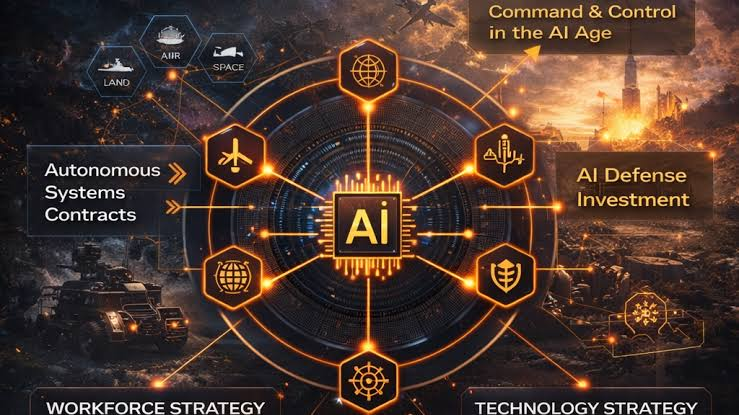
AI command is increasingly connected with autonomous and semi-autonomous systems such as unmanned aircraft and other robotic platforms.
However, there is an important distinction between AI-assisted command and fully autonomous action.
AI-assisted command might help a human understand a situation or compare possible courses of action. More autonomous systems can independently perform increasingly complex tasks.
This creates significant questions about:
- Human control
- Accountability
- Reliability
- Verification
- Cybersecurity
- Unexpected AI behavior
- Compliance with international humanitarian law
NATO’s responsible-AI framework specifically includes govern-ability, requiring appropriate human-machine interaction and mechanisms for detecting unintended behavior and disengaging or deactivating systems when necessary.
Benefits of AI Command
Speed
AI can process information much faster than humans, potentially shortening military decision cycles.
Data Processing
Modern conflicts can generate enormous amounts of information. AI can help filter and organize this information.
Better Situational Awareness
By combining information from multiple sources, AI-enabled systems can provide commanders with a broader operational picture.
Scenario Analysis
AI can help military planners examine different possibilities through simulations and war-games.
Reduced Cognitive Burden
AI can handle repetitive analytical tasks, allowing human personnel to concentrate on higher-level judgment.
Improved Coordination
AI-enabled C2 architectures can help connect information between different units, services, and allied forces.
Major Risks and Challenges
AI command also creates serious risks.
1. Incorrect AI Decisions
AI systems can produce inaccurate outputs. A military decision based on faulty information can have far more serious consequences than an ordinary software error.
2. Bias and Poor Data
AI depends heavily on its training and operational data. Poor-quality or biased data can undermine the reliability of AI-generated recommendations. NATO identifies quality data as a foundational requirement for responsible military AI.
3. Cybersecurity
Military AI systems could become targets for cyber attacks, manipulation, or adversarial interference.
NATO specifically identifies manipulation, sabotage, and interference with AI systems as security concerns.
4. Automation Bias
Humans may place too much trust in an AI recommendation simply because it appears computationally sophisticated.
This makes human judgment and effective oversight particularly important.
5. Escalation
Faster decision-making does not automatically mean better decision-making. If AI systems accelerate military reactions, there may be less time for humans to understand ambiguous situations or consider diplomatic alternatives.
6. Accountability
If an AI-assisted decision causes harm, determining responsibility can become complicated. This is why NATO emphasizes that clear human responsibility must remain attached to AI-enabled military systems.