

By 2025, Chinese open-source large language models will have reached a turning point and will be able to compete fiercely with the best AI systems in the United States. According to David Woo, CEO of David Woo Unbound and former head of macro strategy at Bank of America, in an interview with Financial Sense, this development may provide a substantial obstacle for US IT companies looking to recover their large recent AI investments.
Different Approaches in the Race for AI Arms
According to Woo, both governments see AI as “the decisive battle that the two countries are going to be fighting, vying for global supremacy and economic dominance.” He clarified that the US plan focuses on monopolizing important components of the AI supply chain in order to keep China out. This involves enforcing export limitations and limiting access to cutting-edge semiconductors.
“The US strategy is that we’re going to control every choke point of the technology in the supply chain,” Woo said. “The Chinese are to be starved.” They are working hard to make it as expensive as possible so that only the wealthiest American tech conglomerates can afford it say, the pricey Nvidia processors.”
Why China is betting on open-source
Three pillars support China’s open-source movement: global impact, speed, and sovereignty.
Technological sovereignty is the primary and most pressing motivator. China lacks access to Western models from firms like OpenAI, leaving a gap that local suppliers are keen to fill. China views open models as a strategic imperative due to stringent chip restrictions and a desire for technological independence. Since the United States has the advantage in people, capital, and AI infrastructure, a head-to-head competition utilizing the same closed-loop strategy would probably result in a loss. Rather, China is leveraging its advantages—quick iteration, quick scalability, and open collaboration—by cultivating a thriving open-source ecosystem. It enables China to lessen its reliance on the Western IT stack by developing a self-sufficient AI ecosystem.
How China’s top performers compare to GPT-5
Without effective execution, grand strategy is meaningless. What is the true quality of these Chinese models?
Let’s pit the three titans: OpenAI’s GPT-5, DeepSeek R1, and Alibaba Gwen3-Max.
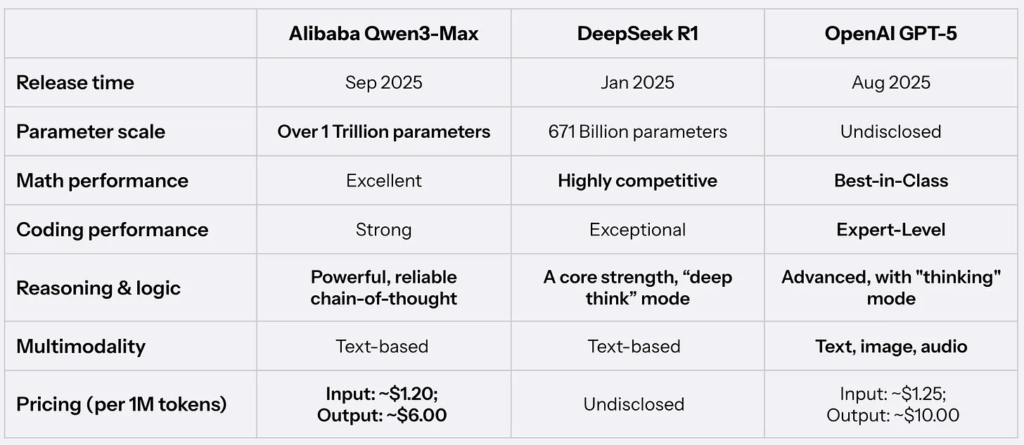
The extent to which Chinese open-source models have been adopted worldwide
Chinese open-source models like Gwen and DeepSeek are becoming more and more popular. With more than 300 million downloads and more than 100,000 derivative models based on Hugging Face, Gwen is one of the most popular open-source AI families worldwide.
Adoption is flourishing in China because of the country’s policy and the lack of Western rivals. The “AI Plus” program, which aims for a 90% penetration rate of AI terminals and agents by 2029, is incorporating these open-source models into a variety of industries, including healthcare and industrial manufacturing.
The path ahead is difficult.
Despite the rapid progress, numerous challenges remain, particularly with regard to the internationalization of Chinese open-source models.
The hardware dependence is the first obstacle. The most cutting-edge chips needed to train frontier AI models are made in the United States and are subject to export regulations. For Chinese businesses attempting to stay up with the next generation of AI, this creates a potential long-term bottleneck.
The trust and regulatory gap is the second, and possibly more challenging, issue. Questions like “Where does our data go?” are constant. Can we have dependable, long-term access? Are there inherent biases in the model? These are not merely technological issues; they are about basic trust, which is a barrier that cannot be overcome by code alone. Therefore, employing Chinese AI models presents severe concerns for Western organizations, particularly in regulated industries, about data protection, compliance with regulations like GDPR, and the long-term geopolitical risk of depending on a technology stack that could be impacted by international conflicts.
What does this signify for multinational corporations?
The multinational corporations are unable to choose just one winner. Rather, they ought to strike the correct equilibrium in order to traverse both habitats.
On the one hand, Western models frequently have superior raw research power and refined, unconventional skills, especially when it comes to sophisticated coding and reasoning. Chinese open-source approaches, on the other hand, present a strong value proposition that includes substantial cost reductions, increased customization, and a degree of openness that permits more control.
This method isn’t plug-and-play. Businesses using this approach must proceed cautiously and adhere to certain guidelines:
- Have a thorough understanding of the regulatory landscape. This includes complicated cross-border data laws and AI-specific legislation in addition to the regulations in your native nation.
- Give data sovereignty first priority. Make sure that reputable local authorities continue to handle sensitive data.
- Keep an eye on the policy environment at all times. Data transfer regulations and export controls are dynamic.
The final result
China has developed a parallel AI stack that functions differently, changes quickly, and fulfills distinct purposes. Its open-source methodology is a purposeful, long-term approach that provides the world with a potent substitute.
Therefore, the question now is not whether multinational corporations should employ these models, but rather how to do so in a safe and calculated manner.
It’s not about picking sides. It’s about becoming ready for a world with multi-polar AI.
The winners will be those that can integrate the advantages of both ecosystems, handling the associated operational and geopolitical risks while striking a balance between performance, cost, and compliance.