
AI security solutions, also known as AI-powered security solutions or AI security tools, use automation and machine learning to assist enterprises in identifying, preventing, and responding to attacks across networks, apps, endpoints, and cloud environments.
AI systems discover patterns from massive amounts of information to detect suspicious behavior, prioritize risk, and suggest next steps more quickly than traditional methods, which mostly rely on static rules and recognized signatures.
The best systems allow teams to work more quickly without sacrificing control by combining automation with governance, which includes clear evidence, explainable alerts, policy restrictions, and human approval for high-impact actions.
AI-Powered security Tools: What Are They?
AI-powered security technologies are security systems that use automation, behavioral analytics, and machine learning to identify, rank, and address vulnerabilities at every stage of the software development life cycle. These tools evaluate code context, look at previous data, and modify their analysis to take into account new attack strategies more quickly than traditional rules-based scanners, which rely on known signatures and identified static behavioral patterns.
Top AI Tools for security
| Cycode | Converged AST + ASPM + SSCS with Dedicated AI Security Layer, including AI Exploitability Agent, Context Intelligence Graph, Ai Visibility, Ai Governance, Ai Guardrails, AI Risk Detection and Maestro AI |
| AI engine combining symbolic and generative AI for SAST, SCA, IaC, and containers | |
| Unified AST platform with agentic AI assistants across SAST, SCA, DAST, and API security | |
| AI noise filtering and 98% false positive reduction for lightweight SAST, SCA, and secret detection | |
| AI-powered SAST, SCA, and DAST with Veracode Fix remediation engine and Package Firewall | |
| CodeQL SAST, Dependabot SCA, Copilot Autofix AI remediation, and secret scanning | |
| Enterprise SCA with multi-discovery analysis, binary scanning, and license compliance | |
| Secrets detection with 350+ detectors, NHI security, and public leak monitoring | |
| SCA with function-level reachability analysis delivering 92% noise reduction | |
| Code quality and SAST platform with AI CodeFix and quality gate enforcement |
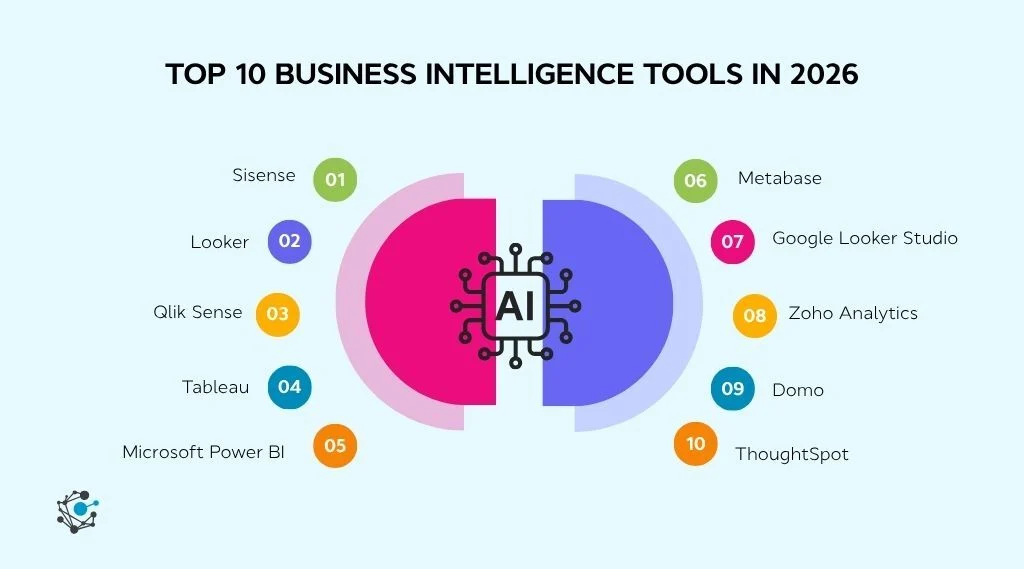
2026’s top ten business intelligence tools (compared)
How well a business intelligence tool fits the data ecosystem, facilitates decision-making processes, and grows with increasing data complexity are all important considerations. The ten BI tools that businesses will most likely assess in 2026 are listed below, arranged according to the areas in which they work best, ranging from corporate reporting to embedded analytics and self-service.
AI’s advantages for security
Selecting the appropriate AI security technology is crucial as more development environments grow and attackers adjust to new tools. These benefits don’t fit the feature checklist. They are about the observable outcomes that have a direct impact on how quickly and safely your teams can deploy software.
- Improved Threat Detection and Accuracy
- Reduced Alert Fatigue and Faster Response
- Stronger Application and Cloud Security Coverage
- Better Scalability for Enterprise Security Teams
Improve Posture with AI-Powered Security Tools from code
- Teams can concentrate on what is truly exploitable in production by using AI exploit-ability Agent, which automatically triages vulnerabilities and reduces false positives by 94%.
- Change Impact Analysis ensures that security efforts remain concentrated on updates that increase risk by automatically identifying high-risk code changes and initiating targeted security workflows.
- Causality, ownership, and risk are mapped across code, pipelines, cloud, and runtime into a single AI-native substrate by the Context Intelligence Graph (CIG).
- Without destroying and replacing current investments, ConnectorX and ASPM Marketplace integrate with more than 100 security products and development platforms, providing teams with visibility in less than five minutes.
- AI Security gives teams a single view of their whole exposure to AI risk by offering a specific violation category with OWASP LLM Top 10 coverage across sass, Secrets, SCA, and Change Impact Analysis.
AI-Powered security: Who Should Use It Now?
AI-driven platforms should be given top priority by IT directors, CISOs, and security teams overseeing intricate networks or sizable user bases. Both businesses with legacy infrastructure and startups with cloud-native systems stand to benefit. Choosing solutions that meet operational demands, legal standards, and scalability objectives is crucial.