

The application of AI, particularly Machine Learning (ML) and Generative AI (GenAI), is expanding quickly in the financial sector, providing chances to increase productivity and provide value. Its application in financial markets, however, may raise dangers and present fresh difficulties for the international financial system. The OECD monitors and evaluates AI advancements and new threats, and it assists policymakers in comprehending how AI functions in the financial sector and in exchanging expertise about rules and laws.
What applications does AI have in finance?
Five broad areas are where AI in finance might be useful: personalizing services and goods; generating opportunities; controlling risk and fraud; facilitating transparency and compliance; automating processes and cutting expenses.
In finance, what is machine learning?
By giving a system a lot of data, machine learning (ML), a subfield of artificial intelligence, enables it to employ deep learning and neural networks to learn and improve on its own without explicit programming. Financial institutions can utilize the data to train models that employ machine learning techniques to address specific issues and provide suggestions for improving these models over time.
Applications: How AI can address actual financial services problems
Identification of speech
Transcribe speech to text to enhance customer care experiences and gain insights from client interactions, including contact center sales calls.
Analysis of sentiment
Utilize natural language artificial intelligence (AI) to detect sentiment in a given text using the prevailing emotional view, such as investment research, chat data sentiment, and more.
Identification of anomalies
Identify irregularities, including financial crime, fraudulent transactions, trade spoofing, and cyber dangers.
Suggestions
Based on client itineraries, peer interactions, risk preferences, and financial objectives, provide highly customized recommendations for financial products and services, such as banking offers or investing advice.
Interpretation
To improve consumer interactions and reach more audiences wherever they are, make your content—such as financial news and apps—multilingual using quick, dynamic machine translation at scale.
Processing documents
For document-intensive procedures like loan servicing and investment opportunity identification, extract structured and unstructured data from documents, evaluate, search, and store it.
Identification of images
Gain insights from photos and videos to speed up customer onboarding with KYC-compliant identity document verification or to evaluate damage to property, such as cars or real estate, in order to expedite insurance claims processing.
Discussions
By offering your customers human-like AI-powered contact center services, such as banking concierge or customer center, you may cut costs and free up the time of your human agents. To transform personal finance and provide customers more ways to handle their money, add intelligent, user-friendly experiences to your apps, websites, digital platforms, and virtual tools.
Benefits of AI in Finance
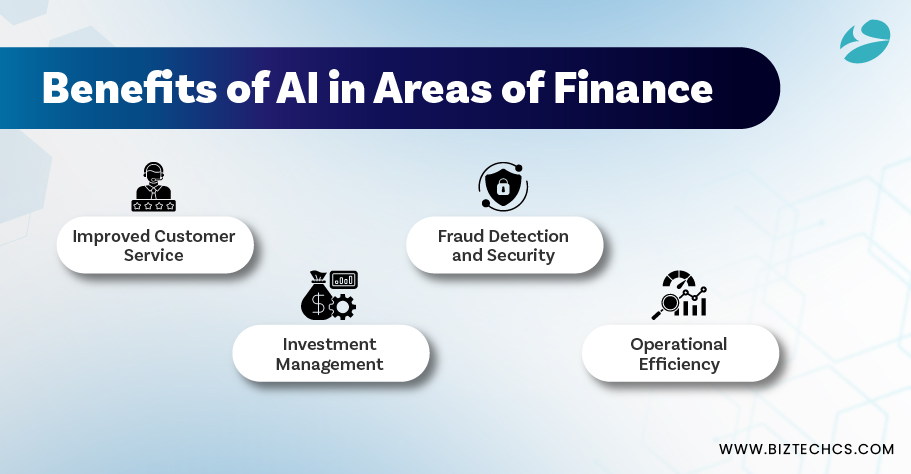
Automation
AI can support decision-making and service delivery, work independently and ethically, and automate workflows and processes. For instance, by continuously monitoring and analyzing network traffic, AI can assist a payments provider in automating some parts of cybersecurity.
Precision
Artificial intelligence (AI) can help financial services companies reduce manual errors in data processing, analytics, document processing, and onboarding through
Effectiveness
People can concentrate on more strategic activities when repetitive jobs are handled by AI. Processes like document verification or summarization, phone call transcription, and responding to consumer inquiries like “what time do you close?” can all be automated with AI. AI bots are frequently employed to replace humans in low-touch or routine work.
Availability
With AI, you may assist your clients in managing and controlling their finances at any time and from any location, as well as in completing financial duties and finding solutions to achieve their objectives. When functioning in the cloud, AI and ML can operate continuously on their assigned duties.
Inventiveness
Rapid data analysis can result in distinctive and cutting-edge goods and services that outperform rivals. Predictive analytics, for example, has used AI to update insurance customer experiences without sacrificing human interaction.
AI’s role in financial services in the future
AI will propel the expansion of financial services. Many businesses have gone digital and discovered new strategies for selling, increasing productivity, and concentrating on their data. In the future, they will need to increase the personalization of relationship-based client interaction. Customized client answers, safer and more responsible product and service recommendations, and the expansion of con
Financial institutions will also need to create distinctive and robust permission-based digital customer