
What is an AI dermatologist?
The phrase AI dermatologist refers to a smartphone application that flags patterns indicative of particular skin problems using image recognition models trained on extensive dermatology photo datasets. It lacks a medical license and is software rather than a human. The free AI Dermatologist program leads you through a single scan from start to finish so you can see what the outcome actually looks like.
AI dermatologist vs human dermatologist vs teledermatology
These three choices range from the quickest and least expensive (AI) to the most comprehensive and costly (in-person dermatologist). The best option will depend on your level of concern, cost, accessibility, and urgency.
- AI dermatologist: instantaneous, free or inexpensive, appointment-free, image-only. Ideal for monitoring, screening, and determining whether to escalate. unable to diagnose. For a more thorough analysis, see the AI mole checker vs. dermatologist comparison.
- Teledermatology: For a price, a licensed dermatologist examines your pictures asynchronously, typically in 24 to 72 hours. able to prescribe and offer a clinical opinion. View our overview of dermatologists online.
- Dermatologist in person: complete physical examination, dermoscopy, biopsy, and prescription. The ideal standard for any persistent or unsettling pain.
How does AI skin analysis work?
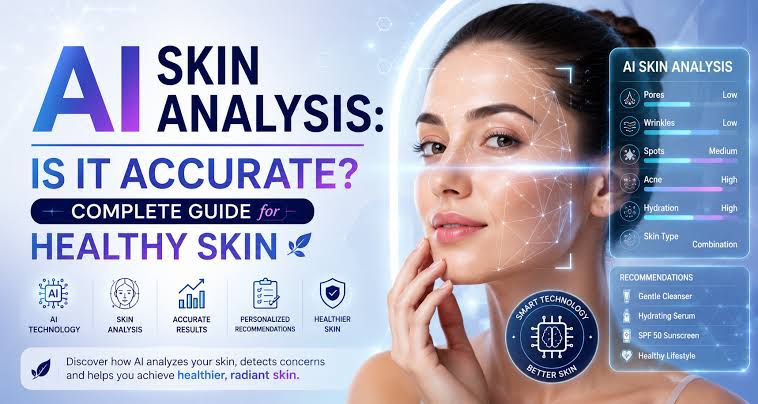
You snap a clear picture or submit it. Instead of a diagnosis, the result is a likelihood score plus context. Additionally, Scan Skin AI saves dated images so you can track changes over time. See the AI Dermatologist tool page for a side-by-side explanation of the workflow (quality check → lesion localization → classification → triage).
Step 1 — Image quality check
Step 2 — Lesion localisation
Step 3 — Classification
Step 4 — Triage and explanation
Who should use an AI dermatologist?
Anyone who wants a fast, low-friction second opinion on a visible skin condition between doctor appointments. especially helpful when waiting times are long or dermatology specialists are far away. The six user categories that benefit most from screening technologies
Privacy, security and regulation
ScanSkinAI complies with GDPR and UK-GDPR regulations while processing images. Images are linked to your account (not sold or used to identify you to other parties), encrypted both in transit and at rest, and only kept for as long as necessary to give your scan history. The underlying organization
An AI dermatologist: what is it?
It is an AI solution for smartphones that uses image recognition to filter visible skin from images. It cannot legally diagnose illness in the majority of jurisdictions and is not a licensed dermatologist.
To what extent is AI skin analysis accurate?
According to published studies, the sensitivity of contemporary dermatological AI technologies for melanoma detection is roughly equivalent to that of general practitioners (88–95%). Image quality has a major impact on accuracy.
Can a dermatologist be replaced with ScanSkinAI?
No, ScanSkinAI is a triage, monitoring, and screening tool. It does not conduct dermoscopy, take biopsies, diagnose illnesses, or recommend treatments.
Is it safe to utilize AI skin analysis?
Indeed, it’s a screening tool. Over-reliance has concerns, such as utilizing AI to ignore a concerning area instead of consulting a physician. AI should be viewed as a second opinion rather than the last word.
Are darker skin tones compatible with AI?
Although they were previously trained on datasets with lighter skin, modern technologies are getting better. Different skin tones are included in ScanSkinAI’s models; a doctor should still examine the results for darker skin.
Is the information about my photos private?
Indeed. Your screening result and scan history are generated using your photos. They are neither used to identify you nor sold. For more information, see our privacy policy.
What happens if AI detects a problem?
Don’t panic, save the picture, and schedule an appointment with a dermatologist or general practitioner within four weeks. Attend the visit with the dated images and the AI result.
teledermatology, in-person evaluation for diagnosis and therapy, or triage and monitoring.
Can my child benefit from AI skin analysis?
Yes, for youngsters with obvious rashes, moles, or skin marks, but always combine the results with a review from a pediatrician or general practitioner. Skin disorders in children change more quickly than in adults, so a clinical examination is crucial.